

A Virtual CIO (vCIO) is an outsourced technology executive who delivers the same strategic IT leadership as a full-time Chief Information Officer, but on a part-time, fractional, or contract basis. You get executive-level planning, budgeting, and security direction without the cost of a full-time hire, sized to what your business actually needs.
Most growing businesses reach a point where technology decisions start to outrun the people making them. Software gets bought reactively, security gaps go unnoticed, and no one owns a plan that ties it all back to where the business is headed. A Virtual CIO fixes that gap. It gives you a seasoned technology leader guiding the strategy, at a fraction of the price and commitment of hiring a Chief Information Officer outright.
Key Takeaways
- A vCIO is fractional IT leadership. You get CIO-level strategy without a CIO-level salary, paying only for the guidance you use.
- The core deliverable is a plan. A vCIO builds a technology roadmap that ties every IT decision back to a business goal.
- It is strategic, not reactive. A vCIO focuses on planning and alignment, not password resets and day-to-day troubleshooting.
- It is not the same as a consultant or an MSP. A consultant solves one project and leaves; an MSP runs the technology; a vCIO owns the strategy across both.
- It fits the smaller-business reality. Most companies need a few hours of high-level direction a month, not a full-time executive on payroll.
What’s in This Guide
What a Virtual CIO Is (and How It Works)
The clearest way to understand a Virtual CIO is by analogy. Many businesses use a fractional CFO, an outsourced financial executive who handles high-level money strategy without joining the payroll full-time. A Virtual CIO is the same idea applied to technology: an outsourced executive who owns the direction of your IT.
That word “executive” matters. A vCIO is not help-desk staff and not a technician. They are not the person who resets a password or swaps a failed hard drive. Their job is the thinking above the day-to-day work: where technology should go, what it should cost, how it stays secure, and how every piece of it supports the business.
In practice, a vCIO relationship usually works in a repeating loop:
- Understand the business. The vCIO learns your goals, growth plans, budget, and constraints before recommending anything.
- Assess what you have. They review your current infrastructure, tools, and security posture to find gaps and risks.
- Build the roadmap. They translate all of that into a prioritized, multi-year technology plan tied to business outcomes.
- Guide execution. They oversee the plan as it rolls out, then recalibrate on a regular schedule as the business changes.
vCIO vs. Traditional CIO vs. IT Consultant
The vCIO role sits between two things people already know: a full-time CIO and a project consultant. Seeing all three side by side is the fastest way to understand where it fits.
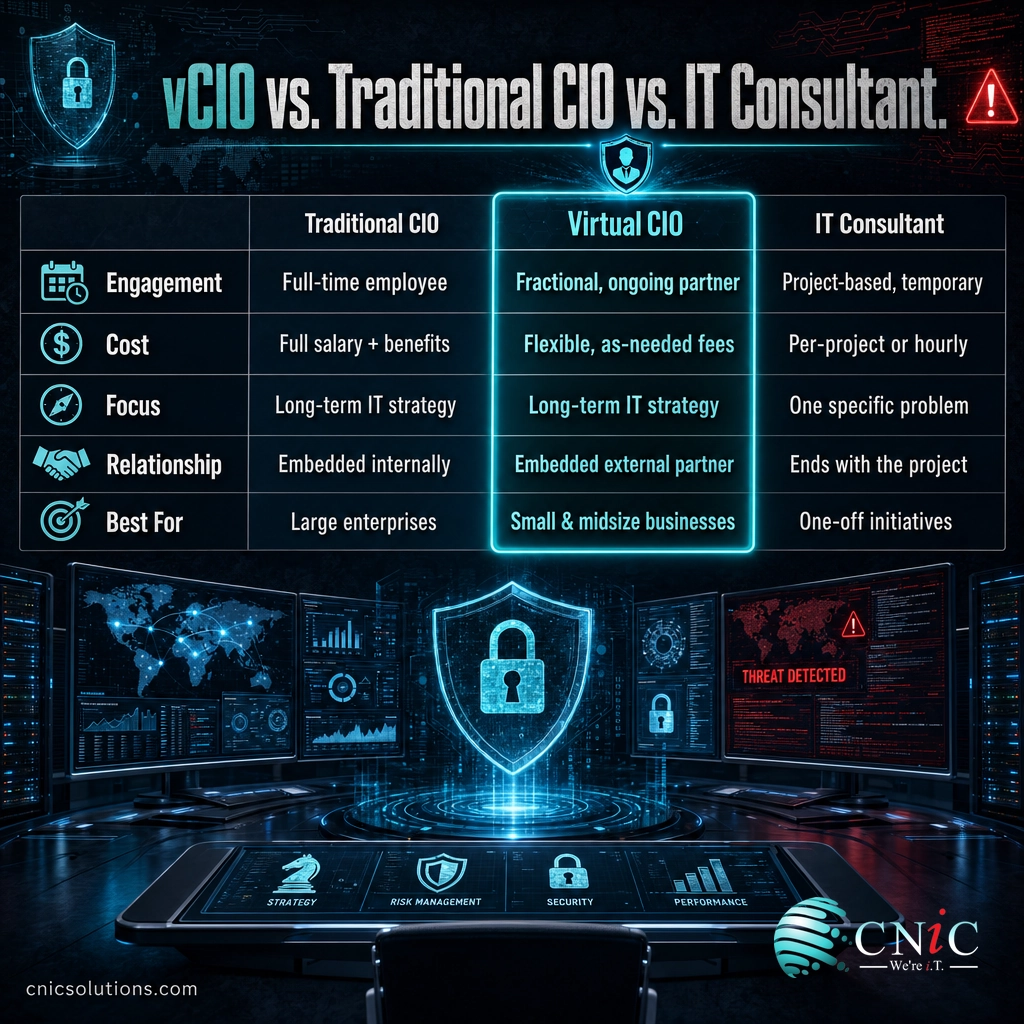
| Factor | Traditional CIO | Virtual CIO | IT Consultant |
|---|---|---|---|
| Engagement | Full-time employee | Fractional, ongoing partner | Project-based, temporary |
| Cost | Full executive salary plus benefits | Flexible, as-needed fees | Per-project or hourly |
| Focus | Long-term IT strategy | Long-term IT strategy | One specific problem |
| Relationship | Embedded internally | Embedded external partner | Ends when the project ends |
| Best for | Large enterprises | Small and midsize businesses | One-off initiatives |
The difference from a traditional CIO is the delivery model, not the value. You get the same strategic thinking, just fractionally and at a cost that matches a smaller company.
The difference from a consultant is continuity. A consultant is hired to solve a defined problem, delivers it, and exits. A vCIO stays. That ongoing relationship means the plan gets adjusted as your business evolves, rather than aging on a shelf the moment the engagement closes.
Myth: A vCIO is just outsourced tech support with a fancier title
This is the most common misunderstanding, and it gets the value backward. Tech support and managed services keep your existing technology running. A vCIO decides what that technology should be in the first place, what to invest in next, and what to retire. One is maintenance; the other is direction. Confusing the two is how businesses end up paying for tools nobody planned for.
What a Virtual CIO Actually Does
Titles are easy to hand out, so the real question is what lands on a vCIO’s plate. Six responsibilities define the role. Every one of them is about planning and judgment, not repair.
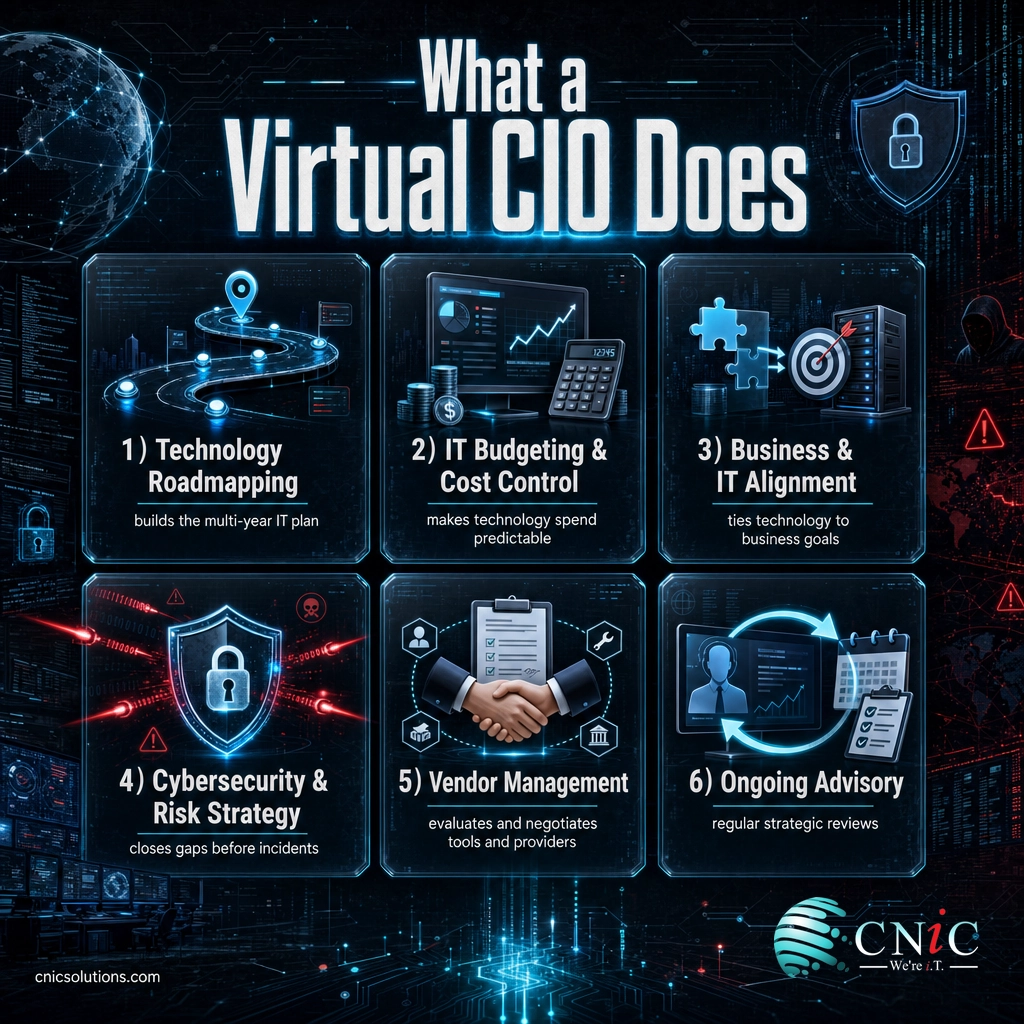
1. Technology roadmapping
This is the primary deliverable. A vCIO builds a multi-year technology roadmap that connects every initiative to a business objective, replacing ad-hoc, reactive spending with a plan you can actually see and budget against.
2. IT budgeting and cost control
A vCIO allocates the technology budget deliberately, prevents wasted spend on premature tools or stalled projects, and makes IT costs predictable instead of surprising. If you have ever struggled to answer “what are we actually getting for our IT spend,” this is the person who answers it. A structured IT budgeting process is a core part of the work.
3. Business and IT alignment
Technology that runs on its own track is expensive and frustrating. A vCIO makes sure IT decisions support what the business is trying to do, so systems help growth rather than block it.
4. Cybersecurity and risk strategy
A vCIO manages security posture strategically through risk assessments, compliance guidance, and gap remediation, closing exposures before they become incidents. For regulated work, that includes mapping controls to frameworks the business has to answer for. This is distinct from a Virtual CISO (vCISO), who focuses purely on security leadership.
5. Vendor management
A vCIO evaluates and manages your technology vendors and software providers, often negotiating better terms and making sure new tools actually work with what you already own, instead of leaving you to manage a pile of disconnected contracts.
6. Ongoing advisory
Because a vCIO typically works across many businesses and industries, they bring cross-pollinated insight to your regular reviews, spotting what is coming and what to avoid based on patterns an internal-only hire would never see.
Why a Virtual CIO Matters
The case for a vCIO comes down to a simple mismatch: technology spending and technology risk have both climbed to a level that demands executive-level planning, but the cost of hiring that executive full-time is out of reach for most small and midsize businesses.
Consider the scale of what is being planned. Gartner forecasts worldwide IT spending will reach $6.37 trillion in 2026, with IT services alone surpassing $1.87 trillion. Technology is one of the largest and fastest-moving line items a business carries, and every dollar of it compounds. Good infrastructure decisions pay off for years; poor ones create technical debt, lock-in, and security gaps that get more expensive to unwind the longer they sit.
Now consider the cost of owning that expertise the traditional way. The median annual wage for a full-time computer and information systems manager was $171,200 in May 2024, with the top tier earning well above $239,000, before benefits and overhead. That is a heavy fixed cost for a company that may only need a few hours of high-level guidance each month.
Annual pay for a full-time IT systems manager (U.S., May 2024)
Source: U.S. Bureau of Labor Statistics | Gartner IT spending forecast
A vCIO resolves that mismatch. The benefits stack up quickly:
- Executive expertise without executive cost. CIO-level strategy, priced to what you use.
- A plan instead of guesswork. Deliberate decisions replace buying whatever breaks next.
- An outside perspective. Experience across many businesses surfaces insights an internal-only hire cannot.
- Flexible scaling. Guidance dials up or down as you grow, with no salary to renegotiate.
- Stronger security and compliance. Strategic risk oversight that is increasingly non-negotiable in regulated industries.
Signs It’s Time to Consider a vCIO
You rarely wake up one day and decide you need IT strategy. It usually announces itself through friction. If several of the following sound familiar, you are at the point where strategic IT leadership starts paying for itself.
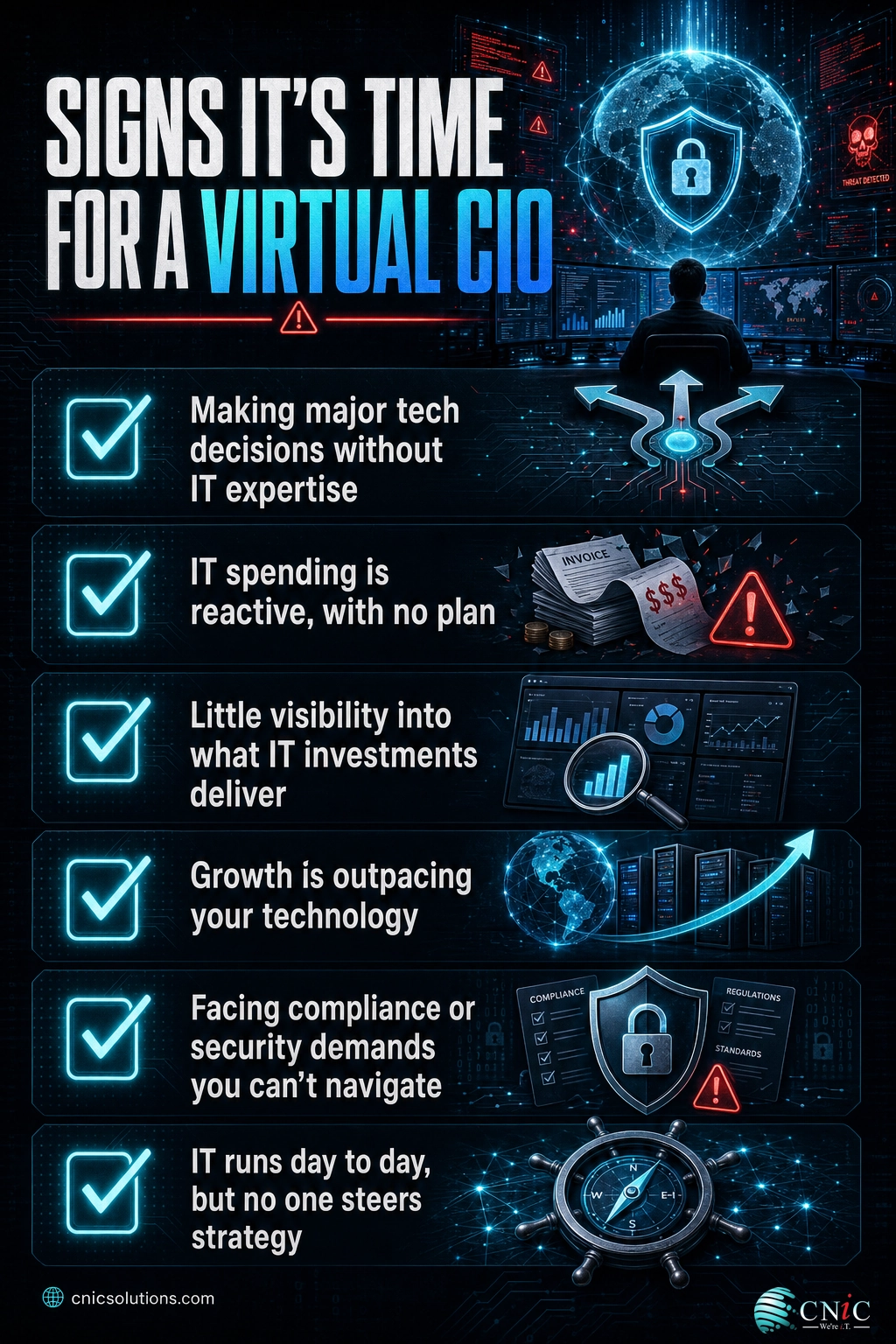
- You are making major technology decisions without any real IT expertise in the room.
- IT spending feels reactive, with no structured plan behind it, you buy when something breaks.
- You have little visibility into what your technology investments actually deliver.
- Rapid growth is outpacing what your current technology can support.
- You face compliance or cybersecurity requirements you cannot navigate internally.
- Day-to-day IT runs fine, but no one is steering the long-term direction.
The through-line is missing leadership, not missing hands. When several of these are true at once, the expensive mistakes that come from steering technology without a guide usually cost far more than the strategic help would have.
How to Choose a Virtual CIO
Not every vCIO engagement is equal, and the differences matter because you are handing over the direction of a major part of your business. When evaluating a provider, weigh a few things:
- Track record. Look for a proven history of aligning technology with business outcomes, and ask for references or case studies rather than taking claims at face value.
- Relevant industry knowledge. A vCIO who understands your regulatory environment and the way your industry actually operates will move faster and avoid costly missteps.
- Communication skills. The whole point of the role is translating technical decisions into business terms leadership can act on. If you cannot follow their explanations, the strategy will not stick.
- A collaborative style. A vCIO works alongside your leadership team, so the ability to build relationships and win buy-in matters as much as technical depth.
- An execution partner behind them. Strategy is only worth what gets built. A vCIO backed by a capable delivery team turns the plan into reality instead of leaving it as a document.
How to Get Started With a Virtual CIO
A vCIO works best as part of a broader managed IT relationship. When the same partner runs your day-to-day operations and provides the strategic leadership above them, reactive maintenance turns into a planned, goal-aligned program. The vCIO sets the direction; the managed IT team executes it. That pairing is also what separates strategy that ships from strategy that never leaves the slide deck. It is the difference between a proactive program and the break-fix approach of only touching technology when it fails.
CNiC Solutions delivers exactly this model. Our Virtual CIO services provide strategic IT planning, a tailored technology roadmap, budgeting and cost optimization, and security and risk management, the full executive-level leadership described above, delivered alongside the hands-on managed IT work that carries the plan out.
Explore CNiC’s Virtual CIO Services
Not sure whether you need strategy, day-to-day support, or both? A full managed IT services relationship folds the vCIO leadership in, so you get the plan and the people to run it from one partner.
See CNiC’s Managed IT Services
Frequently Asked Questions
What is a Virtual CIO (vCIO)?
What does a Virtual CIO actually do?
What is the difference between a vCIO and a traditional CIO?
How is a vCIO different from an IT consultant?
Is a vCIO the same as a managed IT provider (MSP)?
Does a small business really need a Virtual CIO?
Related Terms
- Technology Roadmap: the multi-year plan a vCIO builds to tie every IT decision to a business goal.
- Virtual CISO (vCISO): a fractional security executive focused purely on cybersecurity leadership and risk.
- Managed IT Services: the hands-on team that runs and maintains technology day to day and executes the vCIO’s plan.
- IT Budgeting: the process of planning and controlling technology spend, a core vCIO responsibility.
- Break-Fix IT: the reactive model of fixing technology only when it fails, the opposite of vCIO-led planning.
Sources



related posts
IT OKRs vs. KPIs: How to Measure What Matters
September 17, 2026Most IT reporting drowns leaders in numbers that never answer the only question that matters: is…
IT Cost Reduction Strategies: How Businesses Can Cut Tech Spend
September 17, 2026The most effective IT cost reduction strategies start with eliminating waste you are already paying for,…
Insider Threat Statistics for 2026: Cost, Frequency, and the Human Reality
September 16, 2026Insider threats are no longer a rounding error in the security budget. In 2026, the average…
IoT Security Statistics: Attacks, Vulnerabilities, and Device Growth
September 16, 2026There were 21.1 billion active IoT devices online at the end of 2025, and attackers treat…